What Foo made me notice about bones
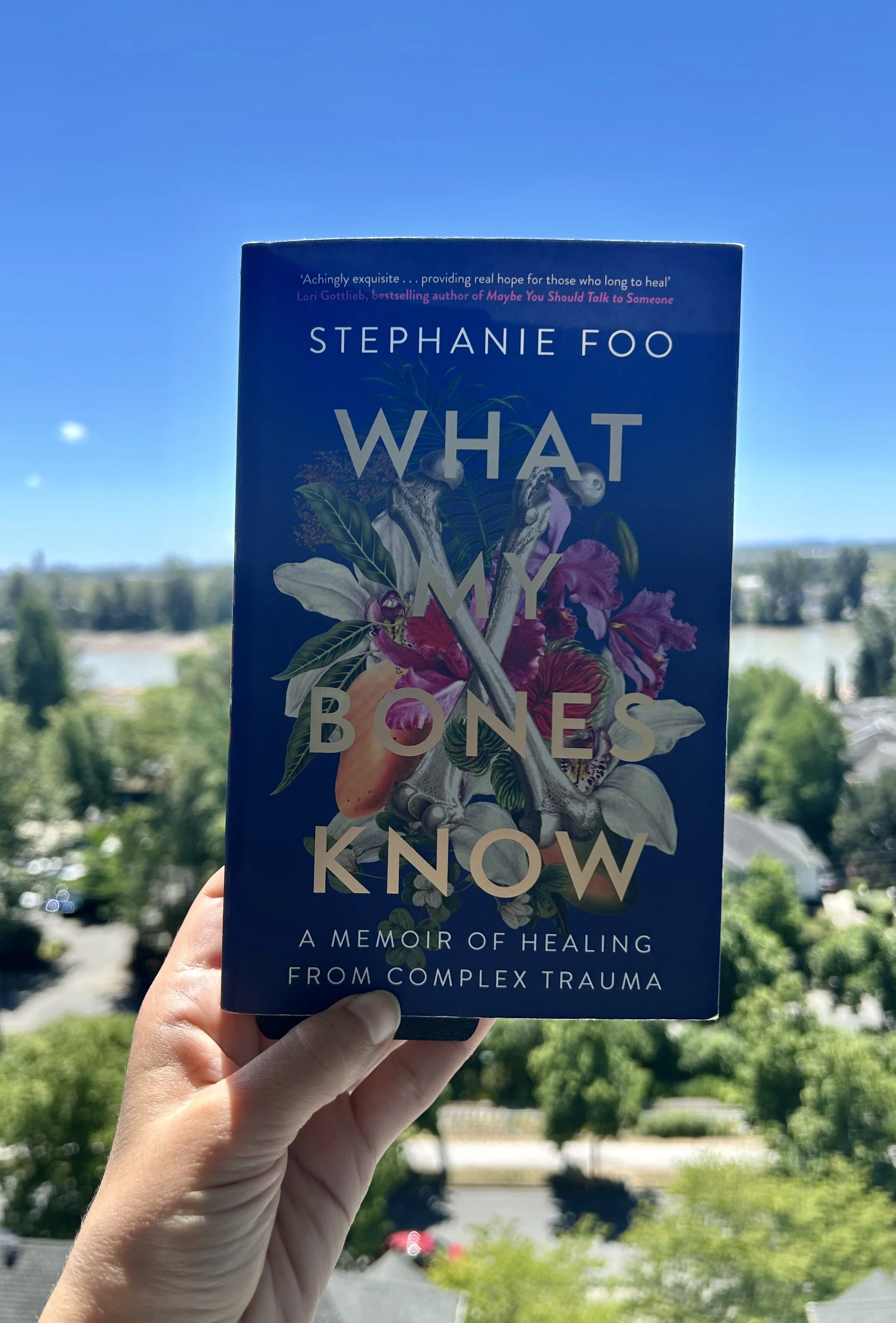
Stephanie Foo talks from the heart, or should I say from the bones? While reading her book, “What My Bones Know”, I could really feel her words emerging from inside her body, travelling through sensations, feelings, until finally becoming language. I ached, I cried, I cheered, and I hoped. Sometimes I wanted to travel in time and space and nurture that little girl who was scared, lost, and desperate to be loved. At the same time, there was something inside of me - a deep and quiet intuitive voice - telling me that Foo had the internal and external resources to love and support that little girl. And so I could return to my role as witness.
The book takes us on a journey of curiosity and compassion. Rather than writing linearly from trauma to diagnosis to healing, Foo offers us a story very similar to the way our memory unfolds. The book wanders through different rooms of the same house. Well, actually, it wanders through different bones of the same body. Diagnosis leads to family history. Family history opens into culture, which opens into curiosity about other people's traumatic experiences. From there, Foo moves toward questions of belonging, research, relational therapy, and eventually an understanding of C-PTSD not as an identity but as a roadmap for management. In this journey, Foo does not present healing as a final destination, but rather as a journey to explore relationships, practices, and conditions that protect and strengthen our bones.
I keep returning to the title “What My Bones Know”. The metaphor of bones feels different from almost all the language we use around trauma. Our bones can break during a forceful impact - sometimes intentional, other times, not. They can also crack when the force is not that intense. Or, if they are overused for a reason or another, they can fracture out of stress. That feels very close to someone put in a traumatic situation. The other thing about bones, though, is that they can repair when provided with the space and resources to do so. The other day, while reading about running, I learned something fascinating. Our bones respond to mechanical stress by sending signals that stimulate bone-forming cells to create new tissue. Scientists call this the Piezoelectric Effect—a wonderfully complicated name for a remarkably hopeful idea: under the right conditions, stress can become part of growth. Interestingly, our ability to answer that signal depends greatly on nourishment. So, I think it is fair to say that bones do not heal simply because they are under stress, but because they are given the materials and support to rebuild when that stress calls for it. Again, that feels very close to someone on a journey to understand and manage their C-PTSD symptoms.
We often talk about trauma, PTSD, C-PTSD as damage. However, bones are here teaching us a different language. One of repair, remodeling, remembering. Again, given the right conditions. Bones do not moralize injury. The pain we feel from its fractures signals that support is needed - and that is when we figure out what the “right conditions” are. It would be fair to say, though, that rest is a big part of it. In the same way I would not expect someone to heal from a stress fracture without rest, I would not expect someone to manage their C-PTSD symptoms without the rest, the space, the time, and the relational attunement needed. The nervous system also needs to rest, more than that, it needs co-regulation. I could witness Foo going through this when she starts working with a therapist who has a more relational approach. Reading those moments, I found myself exhaling. The therapeutic relationship seemed to become less about fixing symptoms and more about creating a place where her nervous system no longer had to survive alone. In that space, triggers could be understood - but so could glimmers.
Perhaps that is what Foo made me notice about bones. They do not heal because they are under stress. They heal because, given the right conditions, they know what to do. I wonder how much of healing asks the same of us - not to become a different version of ourselves, but to trust that, with enough nourishment, rest, and secure relationships, our body might know - or actually, remember - what healing feels like.
